G2’s 2026 Answer Economy research found that 51% of B2B software buyers start their research with an AI chatbot more often than Google. That shift means marketing teams need to track not only traditional search performance but also how AI assistants and answer engines mention, cite, and recommend brands.

HubSpot AEO is one option for continuous tracking and prioritized recommendations, while HubSpot’s free AI Search Grader provides a one-time baseline. HubSpot’s guide to AI-powered brand tracking offers additional context for teams building a broader measurement program.
This guide compares six Ahrefs Brand Radar alternatives for marketing teams that need a different mix of AI model coverage, evidence, integrations, pricing, and rollout fit. It also explains how to connect AI visibility with content performance, pipeline, and broader AI marketing analytics.
Ahrefs is an SEO platform for backlink analysis, keyword research, rank tracking, site audits, competitive research, and AI visibility. Ahrefs Brand Radar now tracks brand mentions and citations across major AI answer engines. It supports custom prompt monitoring, so teams comparing alternatives should evaluate its fit with their current workflow rather than assume Ahrefs lacks conversational AI tracking.
Marketers may still choose another AI visibility tool when they need a different mix of model coverage, prompt-level detail, integrations, evidence, pricing, or reporting workflows. HubSpot AEO is one alternative for teams that want ongoing visibility tracking alongside prioritized recommendations.
Large marketplaces can need more prompt-level context and reporting flexibility than a broad visibility score provides. Alexandra Novikava, a marketer at Truck1, describes her team’s experience:
“At first, we used Ahrefs Brand Radar to observe what sorts of references were being made to us by AI engines but have now transitioned toward custom API tracking and alternative SEO intelligence tools,” Novikava explains.
Novikava says Truck1 needed more detail about the queries where competitors gained visibility and greater flexibility in its data-collection workflow. Ahrefs has since added custom prompt tracking with configurable models, locations, and tracking frequencies, so teams should compare the level of detail they need with Brand Radar’s current capabilities.
In specialized B2B markets, one high-intent prompt can matter more than a broad brand-mention count. Colleen Barry, head of marketing at Ketch, puts it plainly:
“In B2B, one mention in the right context matters more than ten generic mentions,” Barry explains.
Ketch adopted Ahrefs Brand Radar in early 2025 to establish an initial baseline for AI-search visibility. Barry’s team later wanted more control over industry-specific prompt libraries so it could evaluate how conversational engines handled nuanced privacy and compliance queries and determine whether thought-leadership content influenced those responses.
Ahrefs now supports custom prompts, so Ketch’s experience should be read as a historical workflow-fit decision rather than evidence that Brand Radar currently cannot track specific prompts.
Pricing can become the deciding factor when teams compare AI visibility tools. This was Ashot Nanayan’s experience as founder and CEO of B2BSEO. During Brand Radar’s open beta, Nanayan estimated that the Ahrefs subscription and AI-monitoring add-ons his team needed would have cost about $800 per month. He also wanted localized prompt customization and broader model coverage at the time.
Ahrefs’ packaging has changed since that experience. Standalone Brand Radar currently starts at $199 per month for a single platform, while separate custom-prompt packages start at $50 per month. Nanayan ultimately preferred a dedicated AI visibility platform that offered broader coverage and a lower overall cost for his team’s use case.
For Matthew Kinneman, founder of Bully Max, Ahrefs Brand Radar provided a useful starting point for understanding how AI-search platforms referenced the brand. His team moved toward a broader measurement approach because visibility alone did not show whether AI mentions aligned with traffic, engagement, or conversions.
As Kinneman explains, “the biggest lesson for me was that AI visibility is only valuable if you can tie it back to actions customers take afterward. Otherwise, it’s easy to end up optimizing for a metric that looks good but doesn’t drive business growth.”
Today, Bully Max combines multiple data sources to evaluate AI-driven discovery alongside traditional search performance and customer behavior. Rather than treating AI visibility as a standalone KPI, Kinneman argues that teams should evaluate it within the context of the entire customer journey.
His experience reflects one of the most important criteria for evaluating Ahrefs Brand Radar alternatives: marketing teams need to connect AI visibility with CRM, attribution, pipeline, and revenue reporting. HubSpot AEO is one example of a product built around that broader measurement workflow.
These six Ahrefs Brand Radar alternatives offer different combinations of AI model coverage, prompt tracking, citation evidence, integrations, pricing, and reporting depth.
Use this table to compare the core differences before reviewing each tool in detail.
|
Tool |
Key Features |
Best For |
CRM Integration |
Pricing |
Tradeoffs |
|
Brand visibility and sentiment; competitor share of voice and citation analysis; prompt tracking and prioritized recommendations |
Marketing teams that want to connect AI visibility with content and CRM context |
CRM-connected AEO is included in Marketing Hub Professional and Enterprise; standalone AEO does not require HubSpot |
$50/month; $45/month with annual billing |
Tracks ChatGPT, Perplexity, and Gemini; continuous tracking is paid after the 28-day trial |
|
|
Answer Engine Insights; Agent Analytics; Agents and Prompt Volumes |
Larger teams running an enterprise AEO program |
Enterprise API access and integrations |
Starts at $99/month, billed yearly |
Starter tracks ChatGPT only; broader model coverage requires a higher plan |
|
|
Multi-model visibility tracking; citation and competitor analysis; prompt management |
SEO and content teams that need broad model coverage and collaborative workflows |
Looker Studio on Advanced; API and SSO on Enterprise |
Starts at $95/month |
Pricing scales with prompt, project, country, and model requirements |
|
|
Bottom-of-funnel prompt tracking; competitive benchmarking; citation-gap analysis |
SaaS companies and agencies focused on commercial-intent AI visibility |
CRM integration is not a core focus |
Free plan; paid plans start at $99/month |
Narrower focus on buyer and purchase-intent prompts may not suit broad brand-monitoring programs |
|
|
AI Search Score; model-level visibility and ranking results; competitor benchmarking |
Teams that want a free AI visibility baseline |
Standalone diagnostic rather than a CRM workflow |
Free |
Designed for point-in-time diagnosis rather than continuous monitoring |
|
|
ChatGPT prompt tracking; brand mentions and citation evidence; competitor comparisons |
Teams that want ChatGPT visibility and traditional SEO in one product |
CRM integration is not a core focus |
Starts at $69/month |
ChatGPT prompt lookups run weekly, and the tracker has narrower engine coverage than multi-model platforms. |
Bonus diagnostic: HubSpot’s free AI Search Grader provides a one-time baseline across ChatGPT, Perplexity, and Gemini before a team commits to ongoing tracking.
AI visibility tools track brand mentions, citations, and recommendation patterns across AI assistants and AI-search surfaces. Unlike a traditional rank tracker, an AI visibility platform also needs to account for generated answers, preserve evidence, and show how results change over time.
The strongest Ahrefs Brand Radar alternatives should be evaluated on AI model coverage, data freshness, evidence quality, segmentation, integrations, pricing, and team fit.
Model coverage matters because buyers do not rely on a single answer engine. A tool that monitors several AI platforms gives teams a broader view of where a brand appears, while a single-engine tracker can make sense when one platform dominates a company’s audience or workflow.
Data freshness matters for a different reason: AI-generated answers change. Compare how frequently each tool reruns tracked prompts, whether cadence varies by plan or model, and how much historical data the product preserves. Daily data can be useful for active optimization, while weekly or monthly tracking may be enough for broader trend reporting.
Aggregated visibility scores can hide where a brand is actually gaining or losing ground. Segmenting prompts by buyer persona or journey stage helps marketing teams distinguish broad awareness from high-intent consideration and purchase questions.
G2’s 2026 Answer Economy report found that 71% of B2B software buyers rely on AI chatbots at some point in their research process. That makes it useful to measure visibility at more than one stage of the buying journey.
Pro tip: Segmenting by persona prevents a strong aggregate score from hiding an important audience gap. High visibility among developers evaluating APIs, for example, does not mean the brand is equally visible to the marketing leaders who control budget.
Integrations determine whether AI-search insights stay trapped in another dashboard or become part of a team’s existing reporting workflow. Useful platforms can connect AI visibility with CRM data, business intelligence, web analytics, marketing automation, or exportable data that teams can combine with broader AI marketing analytics.
Those connections matter because marketing teams eventually need to compare visibility with traffic, leads, pipeline, and revenue. HubSpot’s 2026 State of Marketing report found that 12.4% of marketers cite difficulty sharing data across their organization as a top challenge. Adding another disconnected measurement tool can make that problem worse.
Reporting quality matters just as much as the integration itself. Historical trends, exportable evidence, custom dashboards, and stakeholder-friendly summaries help teams understand whether changes in AI search engines coincide with changes in content performance and business outcomes.
Pro tip: Look for a tool that preserves historical AI visibility data rather than showing only the latest score. Products such as HubSpot AEO show visibility trends over time, which gives teams a more useful baseline for evaluating content, PR, and brand work.
A visibility score is much more useful when a team can inspect the evidence behind it. Look for products that preserve the underlying AI response, cited sources, timestamps, model information, or other records that make results auditable. That evidence can also strengthen competitive intelligence by showing which sources help competitors appear in recommendations.
Three practical questions can narrow the shortlist.
A lower entry price does not automatically make one AI visibility tool a better fit. Compare the cost of the monitoring program the team will realistically run, not only the cheapest advertised plan.
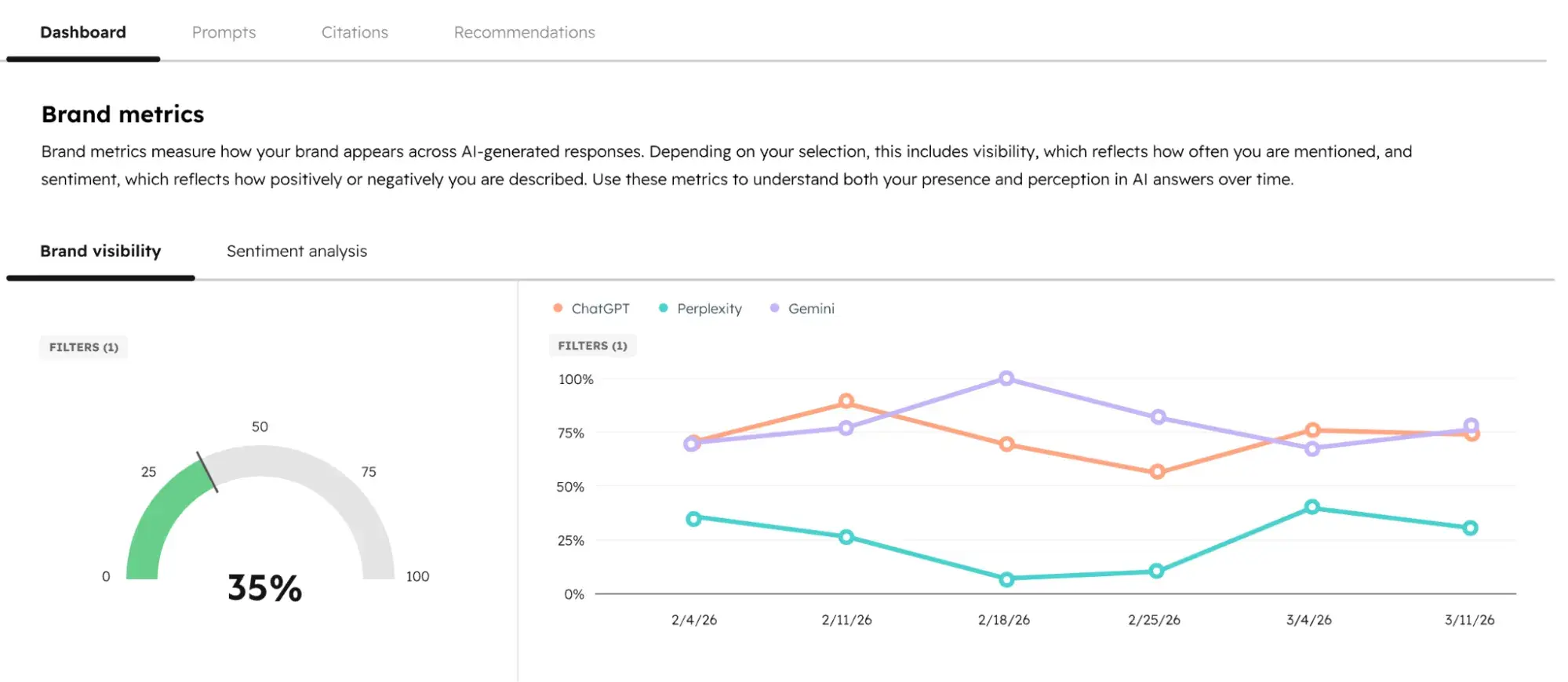
HubSpot AEO is an AI visibility tool that tracks how a brand appears across ChatGPT, Perplexity, and Gemini. It measures visibility and sentiment, compares competitor share of voice and citation sources, tracks buyer-relevant prompts, and turns visibility gaps into prioritized recommendations.
Standalone HubSpot AEO does not require a HubSpot subscription. Marketing Hub Professional and Enterprise include AEO, where CRM data can inform prompt suggestions and recommendations and help teams connect AI visibility with pipeline and revenue.
Key Features
Best for: Marketing teams that want ongoing AI visibility measurement plus a clear workflow for turning findings into content and campaign actions.
Pricing: $50 per month for 25 prompts across ChatGPT, Perplexity, and Gemini, or $45 per month with annual billing. HubSpot offers a 28-day free trial, and teams can purchase additional prompts.
What we like: HubSpot AEO combines measurement with an action layer. Instead of stopping at a visibility score, it shows where competitors are winning, what sources influence those answers, and what the team can do next.
What customers say: One customer success director writes in a G2 review, “I like the potential of HubSpot AEO to bring structure to how we understand and improve our discoverability. The ability to surface gaps in where we’re not being found — and recommend content to fill those gaps — is especially valuable, particularly when it can be filtered by audience or segment.”
Another reviewer writes in a G2 review, “I love the citation analysis in HubSpot AEO. Knowing exactly which domains and content AI engines cite when recommending software in our category has been a genuine game-changer for us. It moved AEO from something abstract we monitored to something we could actively build a strategy around.”
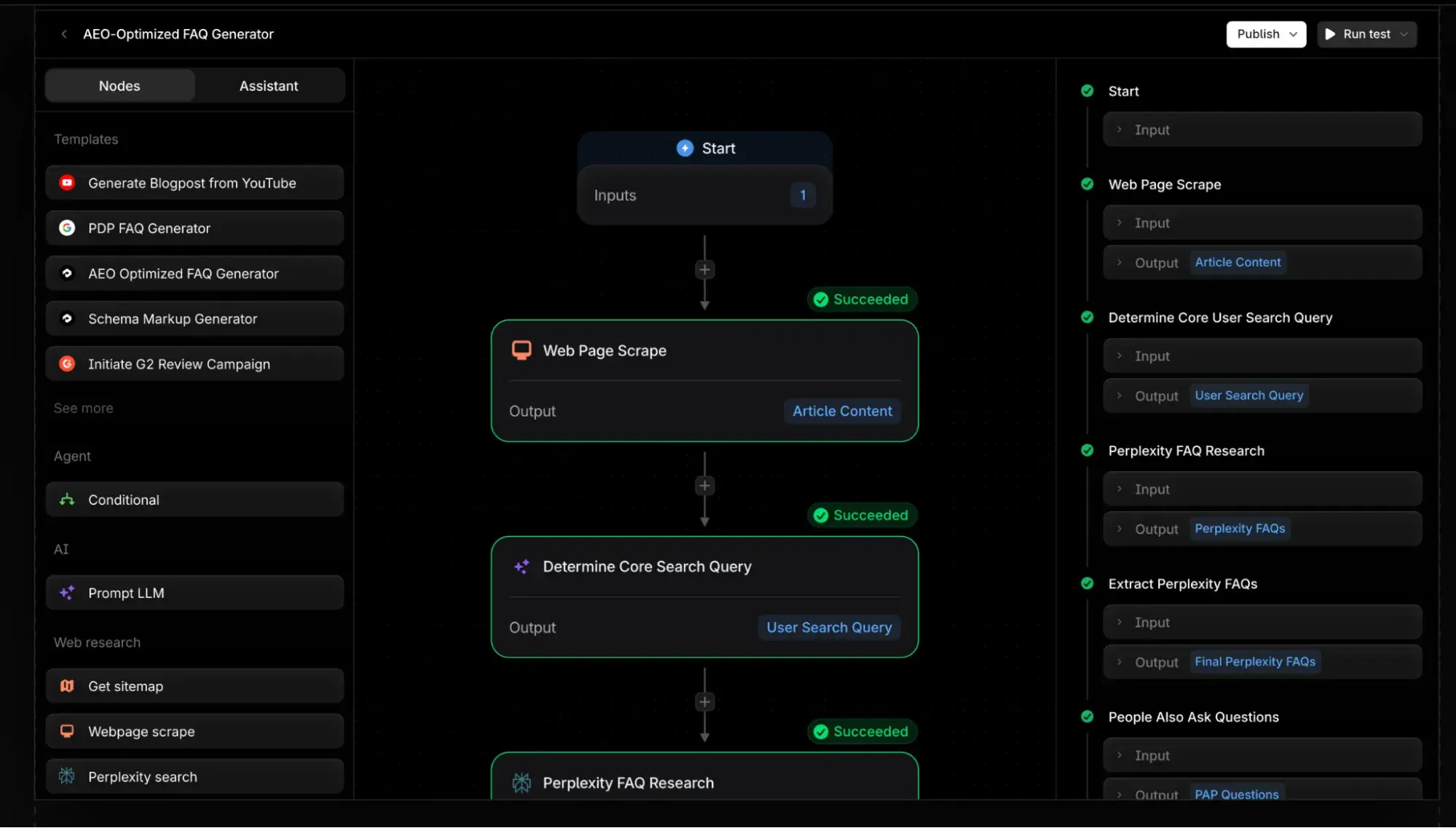
Profound is an AEO platform built for teams that need detailed visibility analysis plus workflows for acting on that data. Its Answer Engine Insights product tracks how brands and competitors appear across AI platforms, while its Agents, Agent Analytics, and Prompt Volumes products extend the platform into content workflows, AI-sourced traffic analysis, and prompt research.
Its public plans range from ChatGPT-only monitoring to broader enterprise coverage, making Profound a stronger fit for organizations that expect AI visibility to become a dedicated program rather than an occasional reporting task.
Key Features
Best for: Larger companies and agencies building a dedicated AEO program that needs detailed reporting, broader model coverage, and enterprise controls.
Pricing: Profound pricing starts at $99 per month, billed yearly, for ChatGPT tracking and 50 prompts. Growth costs $399 per month, billed yearly, and includes three answer engines and 100 prompts. Enterprise uses custom pricing and can add up to nine answer engines.
What we like: Profound goes beyond a single visibility score. Its combination of response monitoring, AI-sourced traffic analysis, prompt research, and enterprise functionality gives teams several ways to build a broader AEO program.
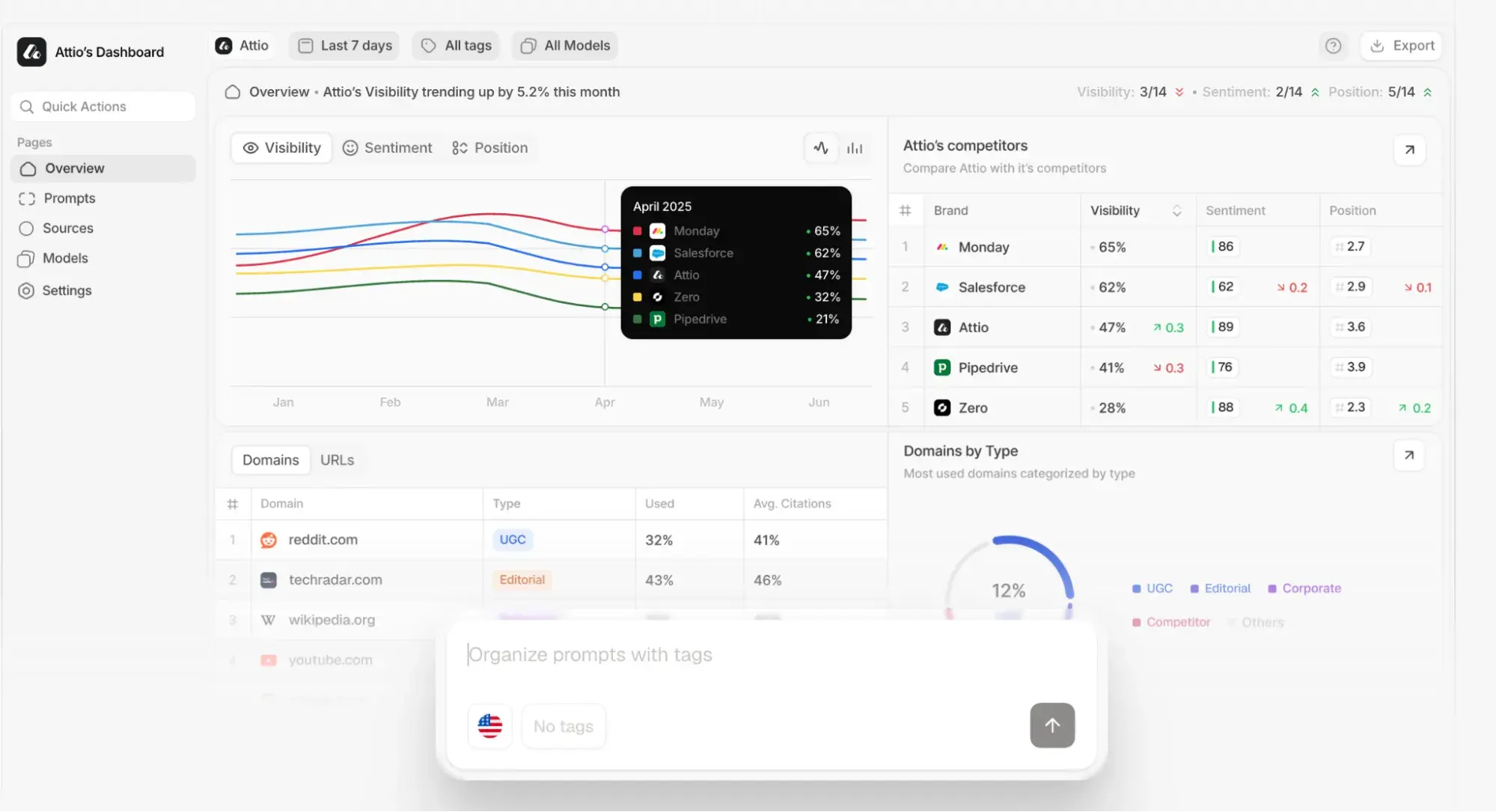
Peec AI is an AI search analytics platform for tracking brand visibility, citations, competitors, and prompts across multiple AI models. Teams can organize prompts by project, compare performance over time, and examine the domains and URLs that appear in AI-generated responses.
Peec complements traditional AI SEO rather than replacing it. Its focus is the answer-engine layer: which brands appear, which sources get cited, and how those patterns change across tracked prompts.
Key Features
Best for: SEO and content teams that need broad AI model coverage, daily tracking, and collaborative access without pricing seats separately.
Pricing: Peec AI pricing starts at $95 per month for Starter with 50 prompts and one project. Pro costs $245 per month for 150 prompts and two projects. Advanced costs $495 per month for 350 prompts and five projects. Enterprise uses custom pricing.
What we like: Peec keeps public-plan user access unlimited while scaling primarily through prompts, projects, countries, and model requirements. That structure can make collaboration easier when SEO, content, and other stakeholders all need access to the same visibility data.
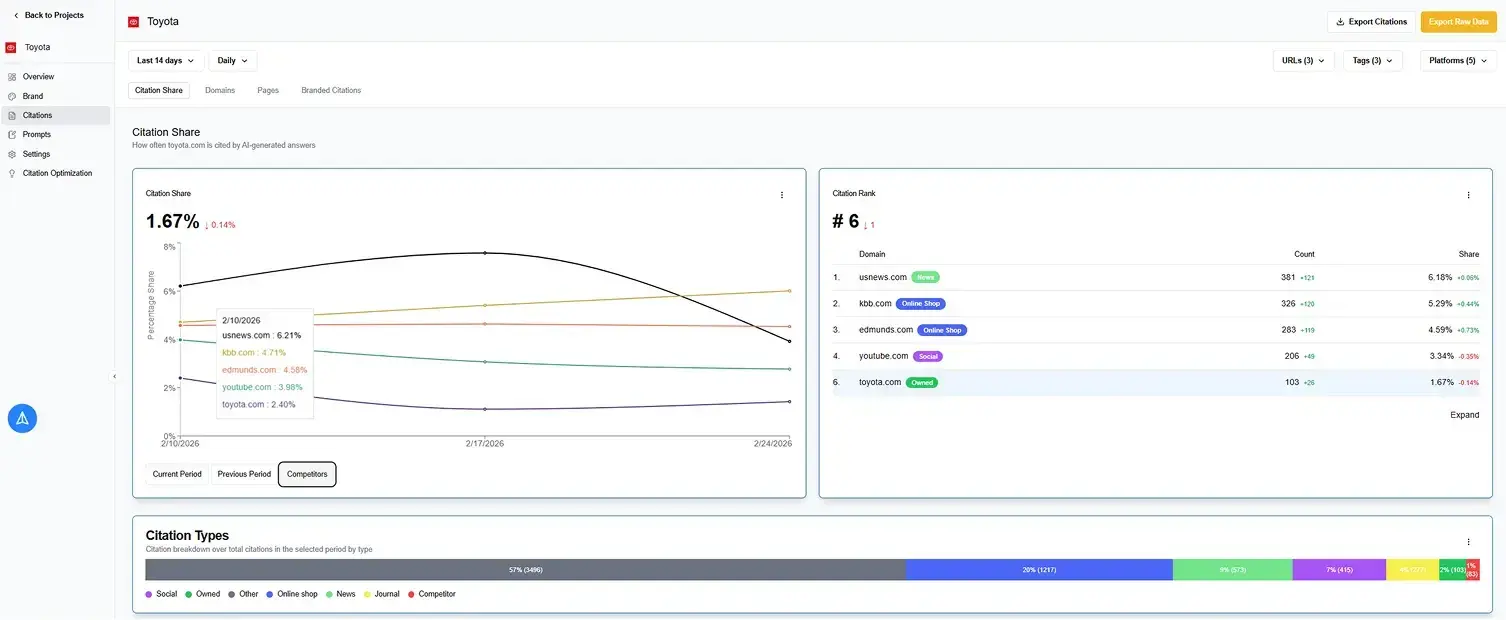
Xofu focuses on bottom-of-the-funnel and purchase-intent prompts — the questions buyers use to shortlist vendors, compare products, and evaluate solutions. It tracks recommendations over time and helps teams see which competitors appear, which sources support those recommendations, and where citation gaps exist.
That narrow focus distinguishes Xofu from broader brand-monitoring tools. It is designed around prompts that sit closer to a buying decision rather than every possible mention of a brand.
Key Features
Best for: SaaS companies, consultants, and agencies that care most about AI visibility in commercial and purchase-intent prompts.
Pricing: Xofu pricing includes a free plan with 50 prompts per model and weekly reporting. Consultant costs $99 per month for 200 prompts per model and weekly reporting. Agency Weekly costs $499 per month for 500 prompts per model. Agency Daily costs $999 per month for 200 prompts per model and daily reporting.
What we like: Xofu keeps the analysis centered on the prompts that influence vendor selection. That makes its reports easier to connect with competitive positioning and pipeline questions than a broad visibility score alone.
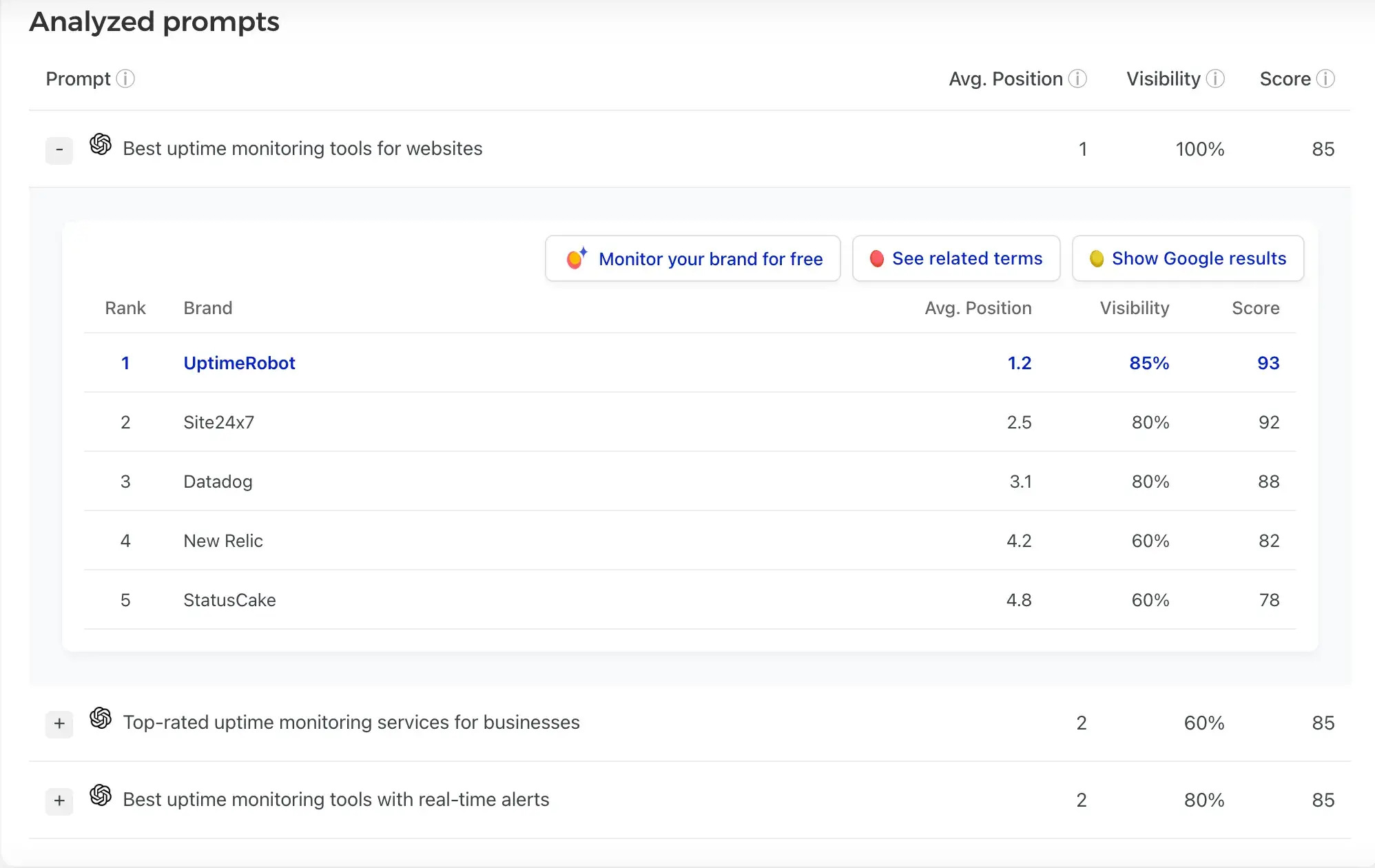
Mangools AI Search Grader is a free diagnostic tool that measures how a brand performs across AI-search models. It combines visibility and ranking into an AI Search Score and shows how the brand compares with competitors for automatically generated prompts.
Users can run the tool without an account using three supported models. A free Mangools account unlocks all seven supported models and additional searches.
Key Features
Best for: Marketers and SEO teams that want a free baseline before investing in continuous AI visibility monitoring.
Pricing: AI Search Grader is free. For continuous monitoring, Mangools offers the separate paid AI Search Watcher product.
What we like: The AI Search Score reduces several visibility and ranking signals to one easy-to-read benchmark while still letting users inspect the underlying model-level results.
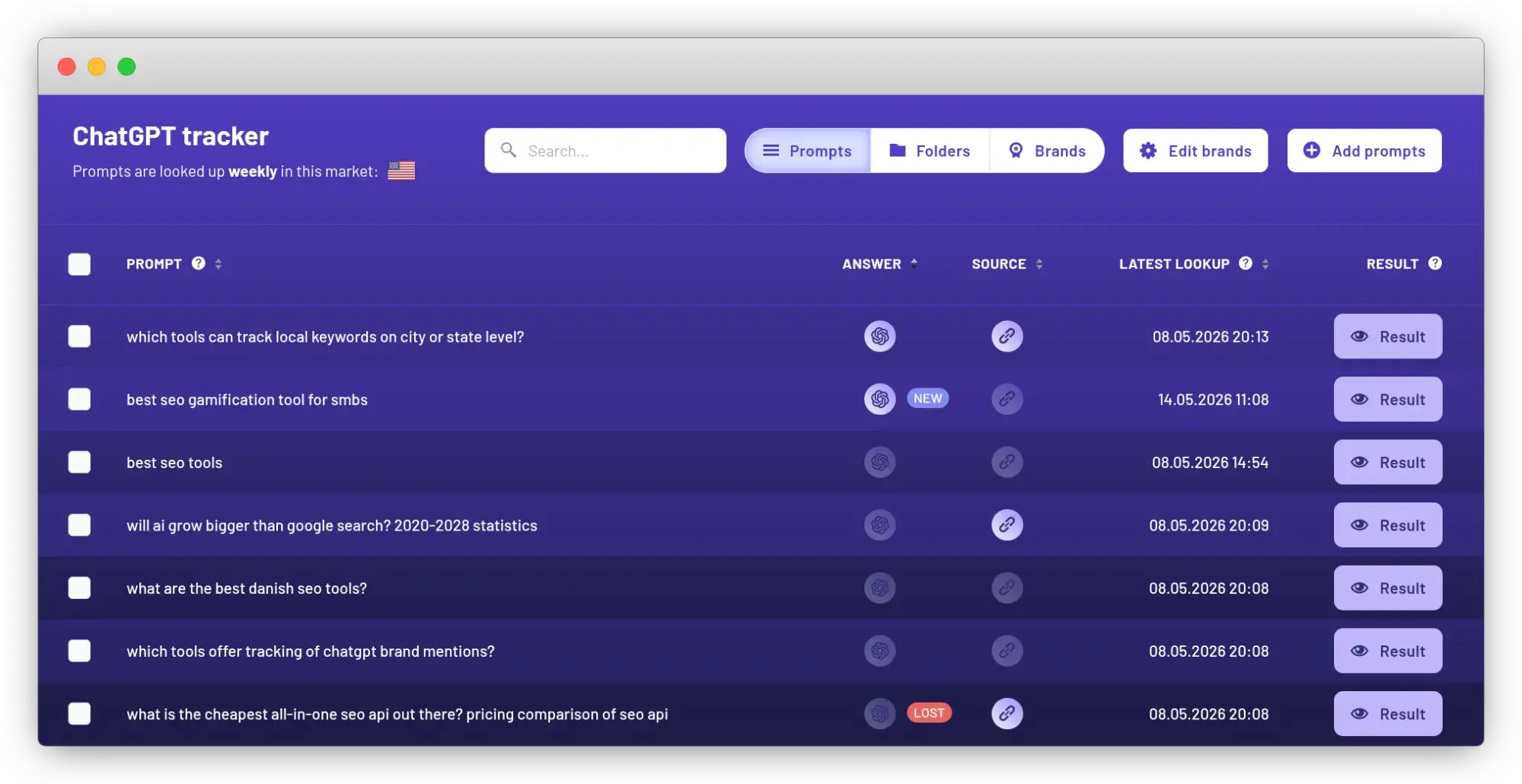
Morningscore ChatGPT Rank Tracker monitors whether ChatGPT mentions or recommends a brand for selected prompts and shows the answer and source evidence behind each result. It sits inside Morningscore’s broader SEO platform, giving teams one place to work with traditional search metrics and ChatGPT visibility.
Its narrower engine focus is the main distinction from multi-model AI visibility platforms: the tracker centers on ChatGPT, and prompt lookups run weekly.
Key Features
Best for: Teams that primarily care about ChatGPT visibility and want that monitoring inside the same product they use for SEO.
Pricing: Morningscore pricing starts at $69 per month for Lite with 10 ChatGPT prompts. Business costs $99 per month for 100 prompts, Pro costs $159 per month for 500 prompts, and Premium costs $299 per month for 2,000 prompts. A 14-day free trial is available without a credit card.
What we like: Morningscore shows the underlying ChatGPT response and source evidence, which makes a reported mention easier to validate than a score alone.
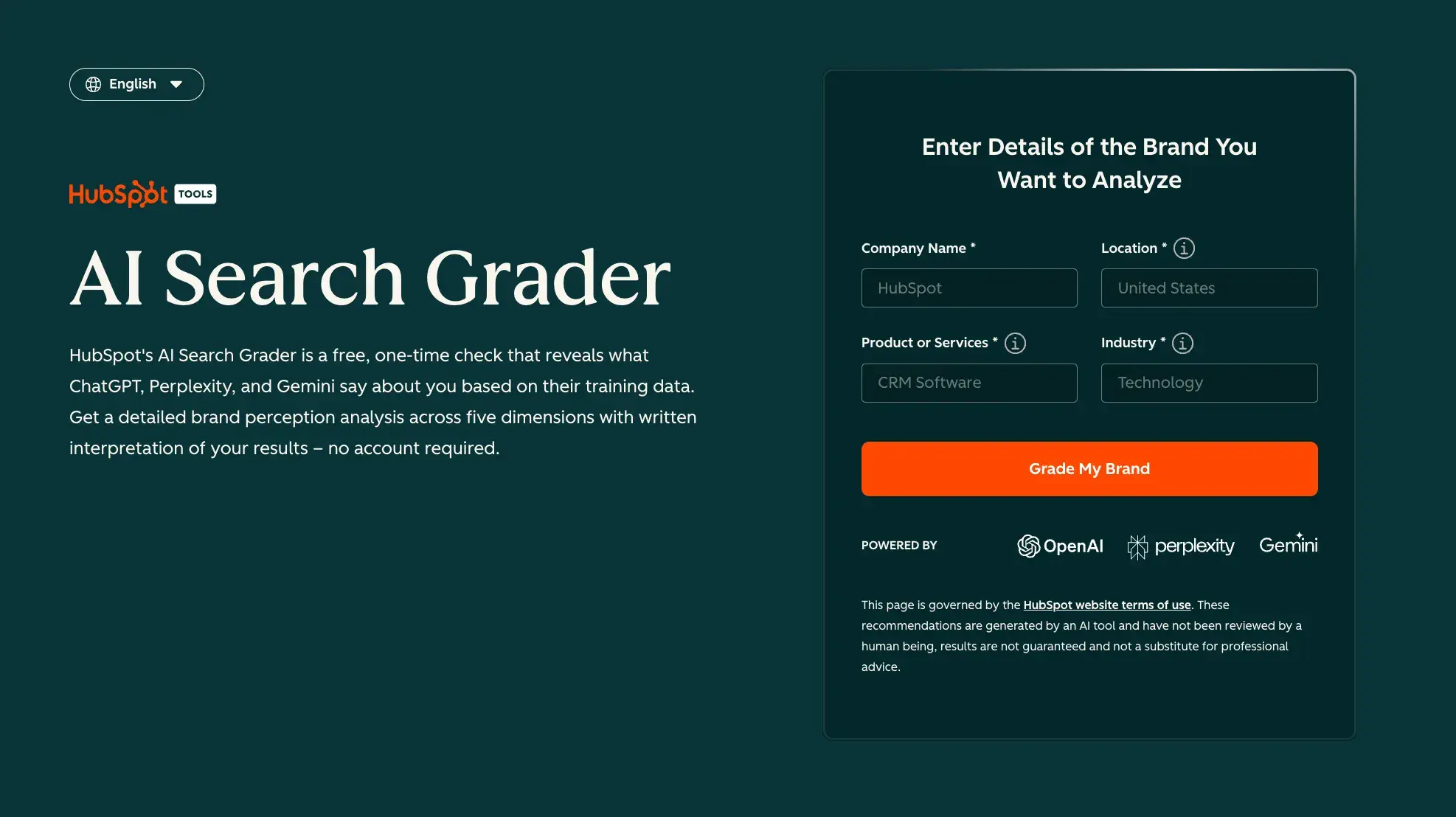
HubSpot AI Search Grader is a free, one-time diagnostic that checks how ChatGPT, Perplexity, and Gemini represent a brand. It scores five dimensions — sentiment, presence quality, brand recognition, share of voice, and market competition — and returns a composite score with written interpretation.
The Grader serves a different purpose from paid HubSpot AEO. AI Search Grader answers “How do answer engines represent my brand right now?” while HubSpot AEO continuously tracks specific prompts, competitors, and changes over time.
Key Features
Best for: Marketing leaders, brand managers, SEO professionals, and content teams that want a free baseline before choosing a continuous AI visibility tool.
Pricing: Free. HubSpot describes AI Search Grader as a one-time check and says no account is required.
What we like: AI Search Grader makes a new measurement category easier to understand. The five-part score gives teams a simple starting point without requiring them to design a prompt-tracking program first.
The Answer Engine Report similarly calls its five-dimension scoring “the most pedagogically useful framework in the directory for explaining what AI visibility actually means to non-specialists.” The review also notes that the report is easier for marketing leaders to understand than many exhaustive practitioner dashboards.
AI visibility becomes more useful when teams can compare it with the metrics that already matter to the business: traffic, leads, opportunities, pipeline, and revenue. An AI visibility product does not need to function as a CRM. Still, its reporting workflow should make it possible to connect visibility trends with the systems marketing and sales teams already use.
The same principle applies to content ROI. Visibility data can show where a brand appears, but teams also need evidence that helps them identify which pages, topics, and sources may be contributing to those results and what they should work on next.
HubSpot’s integrated AEO experience in Marketing Hub Professional and Enterprise uses CRM data to surface prompts that are more relevant to actual buyers. HubSpot also positions that CRM-connected experience as a way to connect AI visibility with pipeline and revenue.
For teams using HubSpot, several products contribute to that workflow.
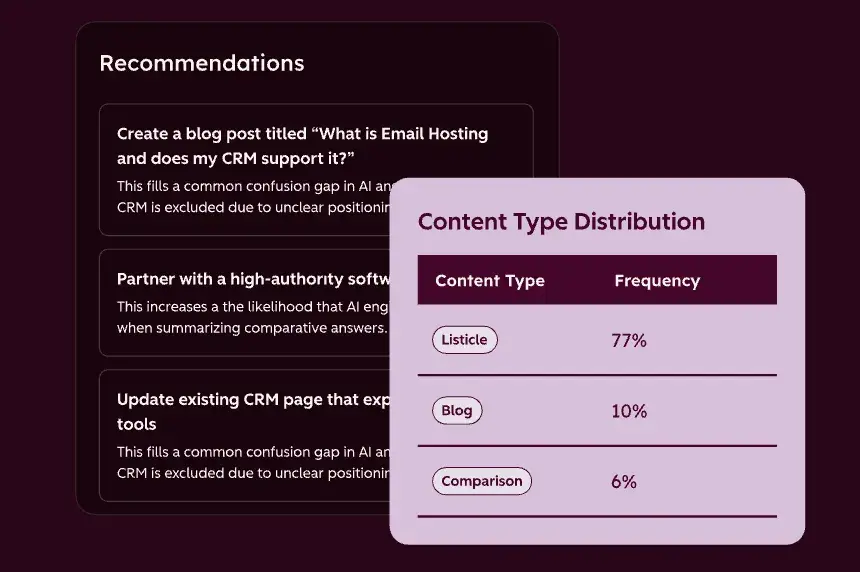
HubSpot AEO also provides prioritized recommendations rather than stopping at a visibility score. Those recommendations can point teams toward content updates, new pages, and citation opportunities based on where the brand is losing visibility.
That turns AI visibility into actionable competitive intelligence: teams can see what brands answer engines recommend, which sources shape those recommendations, and where the brand has an opportunity to improve.
Ultimately, the best Ahrefs Brand Radar alternative depends on the outcome a team needs. Basic mention monitoring may be enough for an early-stage program. Teams that want to connect AI visibility with content performance, attribution, pipeline, and revenue should give more weight to reporting, integrations, evidence, and actionable recommendations.
Implement an Ahrefs Brand Radar alternative as a controlled rollout: establish reporting, standardize prompts, validate results, preserve evidence, and test the workflow before expanding it. The goal is to add a repeatable AI visibility measurement layer alongside traditional search reporting, not to replace SEO measurement entirely.
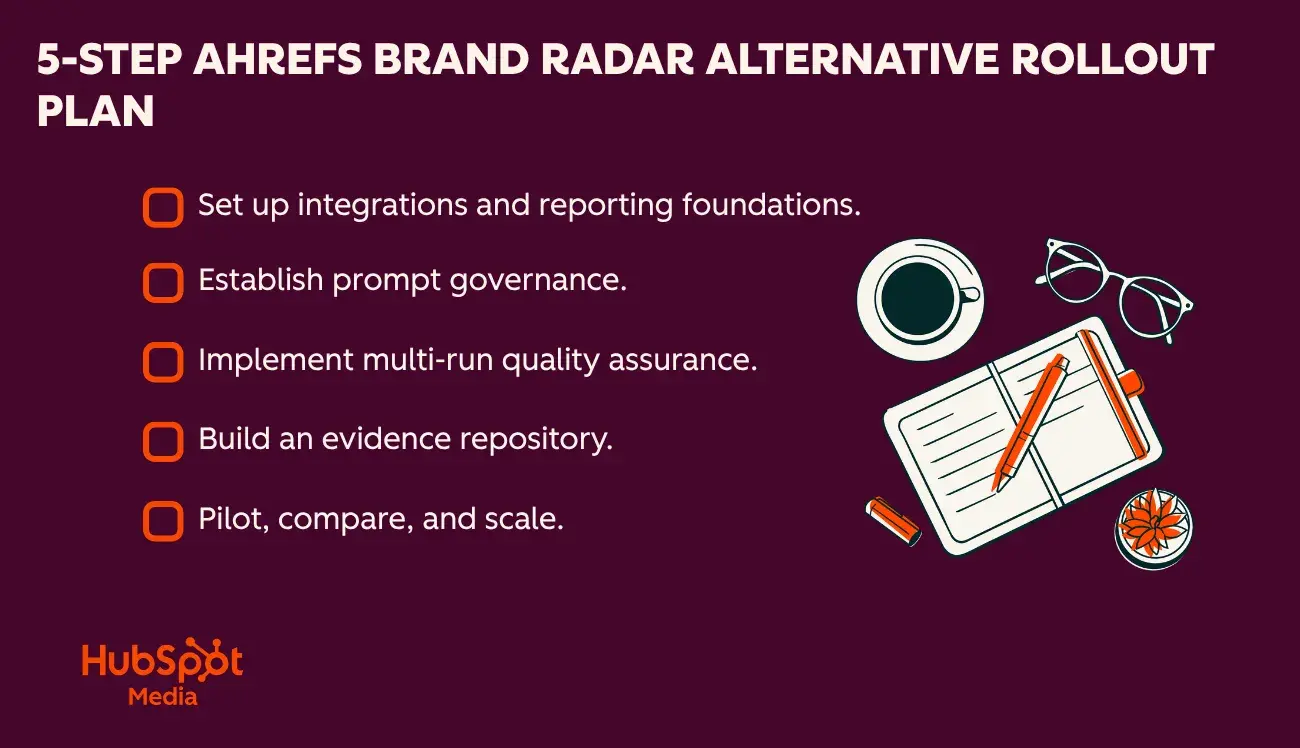
Start by deciding where AI visibility data will live and how the team will compare it with existing marketing and revenue metrics.
Consistent prompts make trend data easier to interpret.
Generated answers vary, so teams should not treat one response as definitive.
Keep enough evidence to explain what happened behind a visibility score.
Test the workflow with a limited prompt set before rolling it out across every product, region, or audience.
Validate AI visibility data by running the same priority prompts more than once and comparing outputs across the models, locations, and tracking frequencies the tool supports. Keep the underlying response and citation evidence so the team can confirm that a reported visibility score matches what the answer engine actually returned.
A new tool can begin collecting baseline data as soon as tracking starts, but there is no universal four-to-six-week window for meaningful results. The time needed depends on the product’s tracking cadence, the stability of the prompt set, changes in the underlying answer engines, and how quickly content changes appear in generated responses.
Some AI visibility tools support geographic segmentation, persona-oriented prompt groups, or both, but capabilities vary by vendor and plan. Use location settings where the product supports them, and organize separate prompt groups around specific buyer roles or journey stages so the comparisons remain consistent.
Connect AI visibility to revenue by bringing visibility, referral traffic, CRM, and attribution data into the same reporting workflow. Compare changes in high-intent prompt visibility with qualified leads, influenced opportunities, and closed revenue, but avoid claiming causal impact when the data only shows a correlation.
Yes. AI visibility trackers and traditional SEO tools answer different questions and work best together. AI visibility platforms show how brands appear in generated answers, while SEO tools measure rankings, backlinks, technical health, keyword opportunities, and organic traffic. For most marketing teams, AI visibility complements traditional SEO rather than replacing it.
Ahrefs Brand Radar is one of several ways to measure AI visibility. The six alternatives in this guide range from free diagnostics and ChatGPT-specific tracking to multi-model platforms built for ongoing reporting, evidence collection, and enterprise workflows. The right choice depends on the models a team needs to monitor, the evidence it needs to preserve, the integrations it relies on, and the cost of running the program at the required scale.
For teams that want continuous monitoring plus prioritized next steps, HubSpot AEO combines visibility, sentiment, competitor citation analysis, prompt tracking, and recommendations. Marketing Hub Professional and Enterprise add CRM context for teams that want AI visibility to sit closer to their existing marketing and revenue reporting.
After reviewing these options, I think the biggest differentiator is whether the data gives a marketing team a clear next action and a credible way to connect visibility with business outcomes. A tool that only produces a score can answer “Are we visible?” A stronger workflow can also help answer “Why?” and “What should we do next?” That is the standard I would use when choosing an Ahrefs Brand Radar alternative.